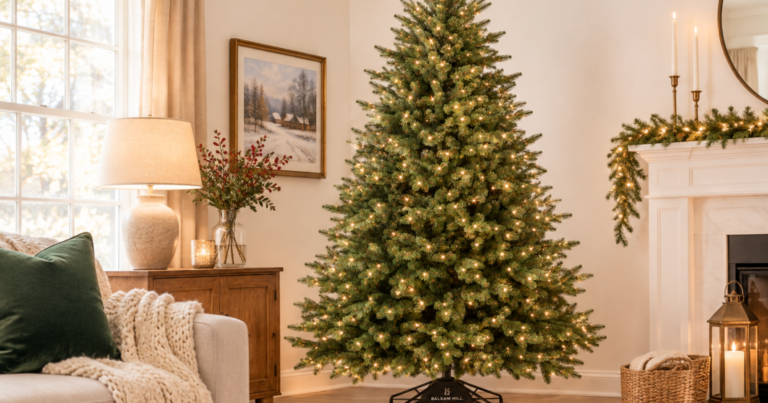
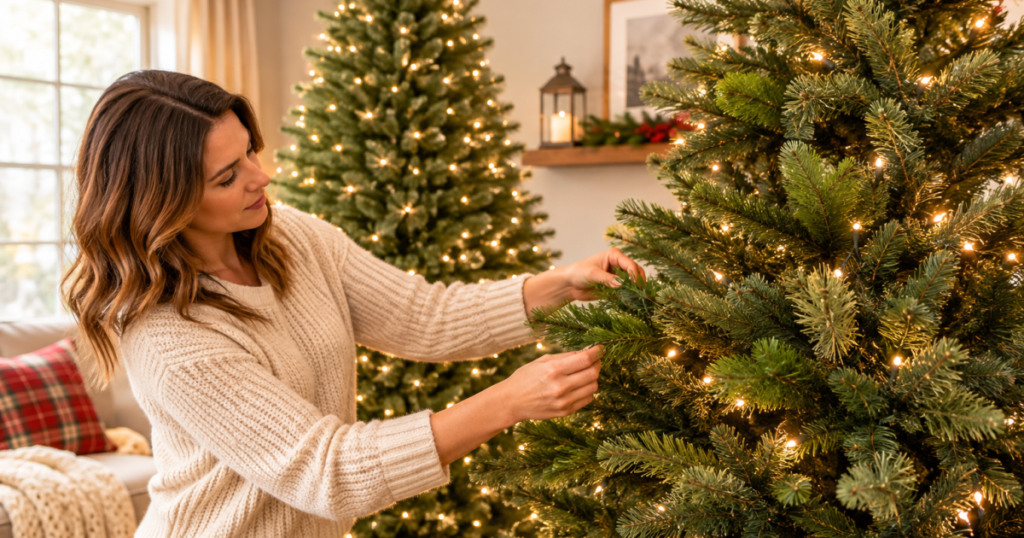
A glowing tree can look magical at dusk and strangely plastic by daylight, so branch material deserves a place in the decision before light settings or ornaments. When shoppers compare a PE vs PVC pre-lit Christmas tree, they are really comparing molded realism, traditional fullness, light-wire camouflage, shaping time, and cost in one choice.
The most realistic-looking artificial trees usually use PE branch tips where the eye lands first, often supported by PVC branches deeper inside the tree. All-PVC trees can still look festive and full, especially once decorated, but they tend to rely more on density, lighting, and styling to create the finished effect.
The big picture
PE stands for polyethylene. On artificial Christmas trees, PE branch tips are typically molded to imitate the shape and dimension of real evergreen needles. They are usually three-dimensional, with a more sculpted profile than flat-cut branch material.
PVC stands for polyvinyl chloride. On artificial trees, PVC is commonly cut into thin strips and attached to branches to create a layered, needled look. It is the familiar artificial tree material many households grew up with: flexible, full-looking from a distance, and often used to build volume.
For pre-lit trees, the branch material does more than affect realism. It changes how visible the light wires are, how the bulbs sit against the branches, how much hand-shaping the tree needs, and whether the tree looks convincing before you add ribbon, ornaments, and a topper.
A helpful rule: choose PE-heavy or mixed PE/PVC construction for close-up realism, choose PVC when budget and fullness are the priority, and choose a thoughtful mixed tree when you want a believable shape without paying for every tip to be molded.
Side-by-side: PE, PVC, and mixed branches

PE branches
- Realism: PE tips are molded, so they can create a more natural branch surface, especially on the outer canopy where guests see the tree up close.
- Fullness: PE is not automatically fuller. A PE-heavy tree can still look open if the silhouette, tip count, or branch spacing is sparse.
- Cost: PE-heavy trees are commonly positioned at higher price tiers than comparable PVC-heavy trees, although brand, height, lighting, and setup design also affect cost.
- Light-wire visibility: Molded outer tips can help the tree look more natural around the bulbs, but wires can still show if the inner branches are thin or poorly shaped.
- Shaping time: PE tips often look more defined straight out of storage, but the tree still needs branch spreading, especially near the trunk.
PVC branches
- Realism: PVC looks less botanical up close because the needles are usually flatter, but it can read as classic and cozy from across the room.
- Fullness: PVC is useful for building visual density. It can create a plush outline, particularly when there are enough branch tips and the tree is well fluffed.
- Cost: PVC-heavy trees are often the more affordable route for a large pre-lit tree, though lighting system, height, and brand still influence the final price.
- Light-wire visibility: Dense PVC can hide wiring well once shaped, but flat needles may catch light differently and make some bulbs look more exposed.
- Shaping time: PVC usually needs more fanning and separating by hand to avoid flat patches, especially after storage.
Mixed PE/PVC branches
- Realism: Mixed trees often place PE tips on visible outer branches and use PVC deeper inside for structure and volume.
- Fullness: This blend can be very effective: PE gives the surface a more natural look, while PVC helps fill the interior.
- Cost: Mixed construction often lands between basic PVC and premium PE-heavy trees, but listings vary widely.
- Light-wire visibility: A good mix can disguise wiring by combining realistic outer tips with fuller inner material.
- Shaping time: Expect some shaping of both materials. The PVC interior often needs the most attention.
What mixed PE/PVC tips really mean in a listing
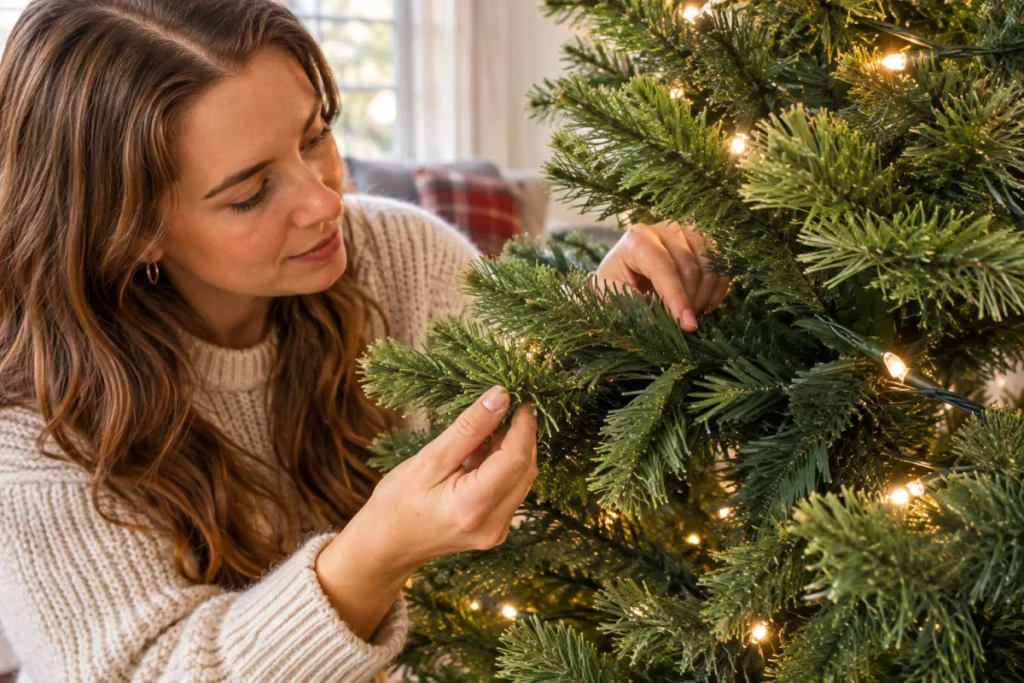
A product listing that says mixed PE/PVC does not necessarily mean the tree is half PE and half PVC. It may mean PE appears mainly on the branch ends, while PVC fills the center. That can be a smart design choice, but the exact balance affects how realistic the tree looks from a sofa, hallway, or dining table.
Look beyond the headline material claim. Check whether the listing states a branch material mix, tip count, light count, maximum diameter, tree shape, and setup style. If those details are missing, rely less on beauty photos and more on close-up images, customer photos when available, and the seller’s written specifications.
For example, a listing such as the Balsam Hill BH Fraser Fir is the kind of detail page where it is worth slowing down and comparing the stated shape, lighting, and branch information rather than judging the tree by one polished room scene.
Realism: PE usually wins up close, but styling still counts

If your tree will sit where people pass within a few feet, PE has the visual advantage. Molded tips give the outer branches more dimension, so the tree can look less like a flat green texture and more like layered evergreen growth. That close-range impression is especially noticeable in daylight, when ornaments and lights are not doing all the work.
PVC can still look inviting, particularly in evening light. Warm white bulbs, dense ornament placement, ribbon, picks, and a well-chosen tree collar can soften the flatter needle effect. A PVC tree in a cozy corner may feel more successful than a PE-heavy tree that is too wide for the room or shoved against furniture.
Flocked trees add another wrinkle. Snowy finishes can disguise some differences between PE and PVC because the flocking becomes part of the visual surface. A tree such as the King of Christmas Prince Flock Tree is a reminder to judge the whole finish, not only the underlying branch material. With flocking, outline, density, and how evenly the snow effect appears can be just as important as the needle type.
Fullness: PVC is the quiet workhorse
Fullness is not the same as realism. A very realistic branch can still leave gaps if there are not enough tips or if the tree has a narrow profile. PVC is often used because it fills space efficiently. It can create the dark green interior that keeps the trunk, poles, and wiring from becoming the first thing you notice.
That is why many strong-looking trees use both materials. PE creates the outer impression; PVC supports the volume behind it. If a mixed tree looks lush in close-up photos and still has a balanced outline in full-room images, that is usually a better sign than a material label alone.
For slim and pencil trees, fullness has a different job. The tree does not need to look massive; it needs to look intentional. Narrow trees can appear elegant when the branch layers are consistent from top to bottom, but they can look thin if the interior is underfilled. A pencil-style listing such as the National Tree Company Kingswood Fir Pencil Slim is useful to compare because shape and maximum diameter affect the final impression as much as branch material.
Light behavior: branches change how the glow lands
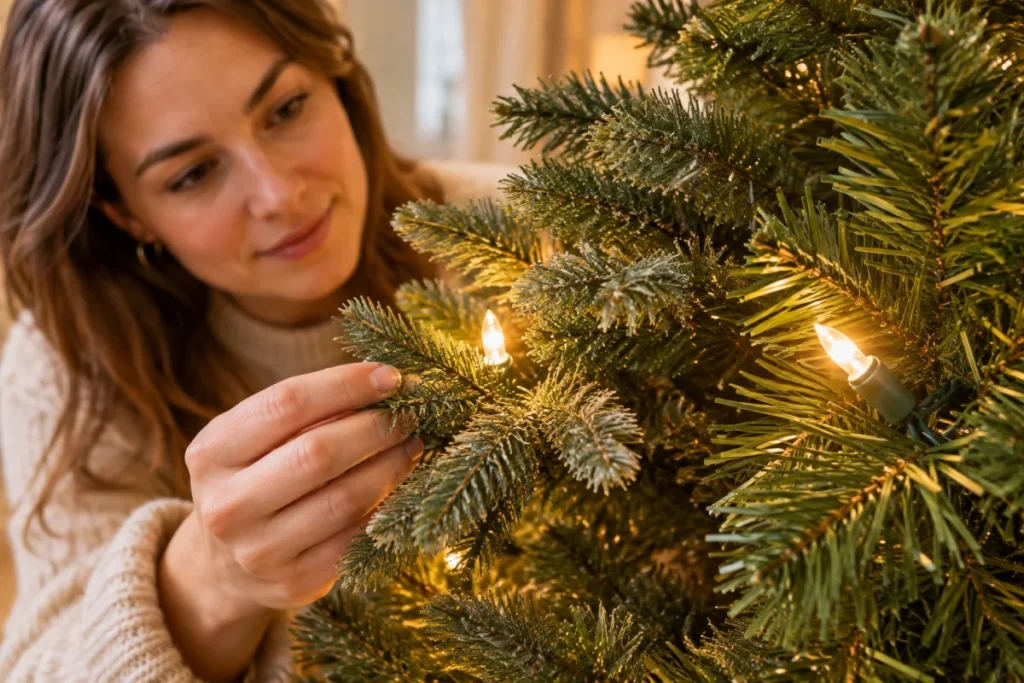
Pre-lit trees add a second layer to the PE-versus-PVC decision. The built-in lights are fixed to the branches, so you are not only buying needles; you are buying how those needles frame the glow.
On PE-heavy outer branches, bulbs can look more integrated because the surrounding tips have more shape. On PVC-heavy branches, the light may appear brighter against flatter needles, which some people enjoy for a classic sparkle. Neither effect is automatically better. It depends on whether you want the lights to feel nestled into the tree or more visibly decorative.
Light density also changes the result. A tree with abundant lights can distract from less realistic branch material, while sparse lighting can make gaps and wires easier to notice. A lighting-forward tree such as the Twinkly Pre-lit Tree Multicolor + White 7 ft Type A shows why shoppers should consider branch construction and lighting style together, rather than treating them as separate decisions.
Cost: what you are usually paying for
PE-heavy construction generally costs more because molded tips are more involved than flat-cut PVC foliage. That does not mean every expensive tree is automatically better, and it does not mean a PVC tree is a mistake. It means the price should line up with the parts of the tree you will actually notice and enjoy.
Spend more on PE or a higher-quality mixed tree if the tree will be a main-room centerpiece, if you prefer lighter decorating, or if you want the branches themselves to carry the look. A more realistic branch surface is easiest to appreciate when it is not buried under oversized ornaments and wide ribbon.
Spend less on PVC if you enjoy a highly decorated tree, need a larger height without stretching the budget, or mainly view the tree in evening light. Dense PVC can be very cheerful once shaped and dressed. The trick is to plan for fluffing time and use decorations that add depth rather than trying to make the branch material do everything.
How to inspect a pre-lit tree before you commit

Start with room fit, then material. A beautiful PE tree that crowds a walkway will become irritating long before anyone admires the needle molds. For standard rooms with 8-foot ceilings, many shoppers look at 7-foot to 7.5-foot trees, leaving space for a topper and stand. Also measure corner depth and the path around the tree, not just ceiling height.
Next, check the silhouette. Full trees feel grand but need floor space. Slim trees preserve walkways. Pencil trees suit tight corners, bedrooms, apartments, and small dining areas, but they need careful decorating so they look styled rather than squeezed in.
Then read the branch information carefully. If the listing uses phrases such as realistic, lifelike, or natural, look for the material explanation behind the claim. PE, PVC, and mixed PE/PVC are useful terms only when paired with shape, tip count, lighting, and photos that show the tree from more than one distance.
Finally, consider your decorating habits. If you love heirloom ornaments, garland, ribbon, and a generous topper, a full PVC or mixed tree may serve you beautifully. If you prefer a quieter tree with fewer ornaments and more visible branches, PE content becomes more important.
Styling each branch type so it looks its best
PE branches usually benefit from restraint. Let some of the molded tips show, especially on the outer edges. Use ornaments with breathing room, tuck smaller pieces slightly inward, and avoid covering every branch end with ribbon. The point of paying for a more realistic surface is letting it be seen.
PVC branches reward layering. Fan the tips in different directions, then add ornaments at multiple depths: some close to the trunk, some mid-branch, and some near the outside. Ribbon, berry picks, pinecone picks, and reflective ornaments can create dimension where the needles themselves are flatter.
Mixed trees need both approaches. Treat the PE outer tips as the display layer and the PVC interior as the shadow layer. Place larger or darker ornaments deeper in the tree to add depth, then reserve delicate, detailed ornaments for the outer PE tips. If you want a more structured decorating order, the step-by-step approach in decorating a pre-lit Christmas tree can help you work with the built-in lights instead of fighting them.
Which branch material should you buy?
Choose a PE-heavy pre-lit tree if realism is your top priority and the tree will be seen up close in a main living space. This is the strongest choice for lighter decorating schemes, natural woodland looks, and rooms where the tree is part of the daytime decor as well as the evening glow.
Choose a PVC pre-lit tree if you want maximum size and fullness for the budget, plan to decorate generously, or enjoy the nostalgic look of a classic artificial Christmas tree. PVC is not the most realistic up close, but it can deliver a warm, abundant holiday effect with good shaping and thoughtful ornament placement.
Choose a mixed PE/PVC pre-lit tree if you want the most balanced route. For many homes, this is the sweet spot: molded outer tips where realism shows, PVC inside where fullness is needed, and a price that may be easier to justify than a heavily PE construction. Just remember that mixed can mean many different things, so compare the actual listing details.
Questions people ask
What is the easiest way to compare a PE vs PVC pre-lit Christmas tree online?
Compare the branch material, full-tree photos, close-up branch photos, light count, tip count, maximum diameter, and setup style together. Material alone is not enough because a sparse PE tree may look less satisfying than a dense mixed tree in the same room.
Are PE branches always better than PVC?
No. PE usually looks more realistic up close, but PVC can create fullness, hide the interior, and keep costs lower. The better choice depends on viewing distance, decorating style, tree size, and budget.
Does a higher light count make PVC look more realistic?
More lights can make a PVC tree feel brighter and more festive, but they do not change the branch shape. Lighting can distract from flatter needles in the evening, while daylight will still reveal the material more clearly.
Why it matters
For the most realistic look, favor PE or a well-designed mixed PE/PVC tree with molded tips on the visible outer branches. For the fullest look at a more accessible cost, PVC remains a practical choice, especially if you enjoy a decorated, glowing, traditional tree. For most shoppers, the best answer is not a material in isolation but a combination of branch mix, silhouette, light style, room size, and how much shaping you are willing to do each season.
A pre-lit tree is the holiday centerpiece you will meet again every November. Choose the branch material that supports the room you actually have, the decorating routine you enjoy, and the kind of Christmas glow you want to come home to.