
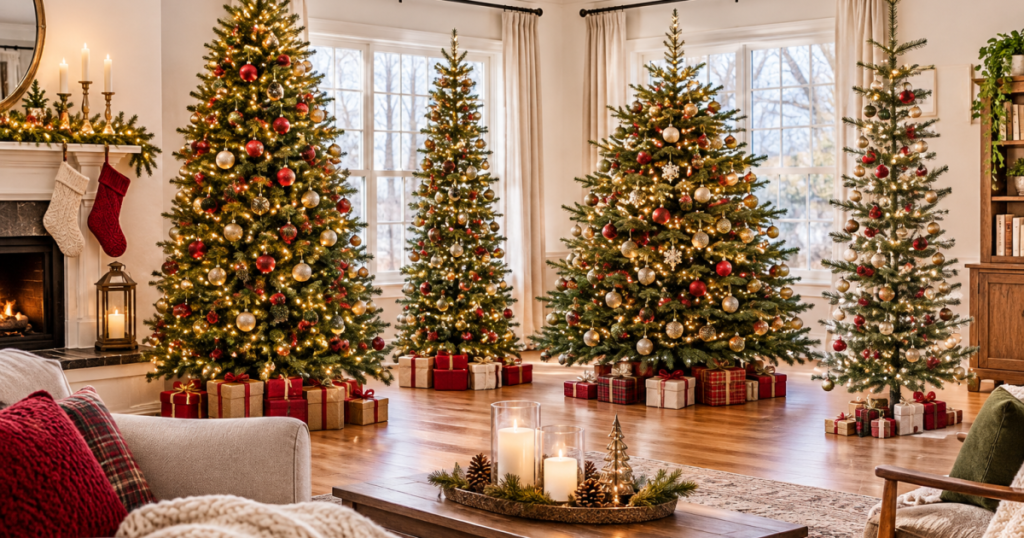
The same ornaments can look cozy, dramatic, or oddly cramped depending on the tree beneath them. Understanding tree silhouettes helps you choose a pre-lit Christmas tree that supports the room instead of fighting its walkways, furniture, and ceiling line.
Shape is the first styling decision, even before ribbon color or topper height. A full tree creates a different holiday mood than a pencil tree, and a flocked shape changes the visual weight before you add a single bauble.
Main points
- A full tree feels classic, generous, and formal, but it needs enough floor space around the base to avoid crowding the room.
- A slim tree keeps the Christmas focal point without taking over a seating area, hallway edge, or apartment living room.
- A pencil tree reads tall and tailored; it works best when styled intentionally rather than loaded like a wide family tree.
- A flocked tree looks visually heavier and softer because the snowy finish adds brightness and texture across the branches.
- The best shape is the one that leaves comfortable walkways, suits your ornament collection, and looks balanced from the main seating angle.
How tree silhouettes change the room before decorating starts
A Christmas tree is not just vertical decor. It changes how the room feels because it claims floor space, draws the eye upward, and creates a lit outline in the evening. The wider the tree, the more it reads as a traditional centerpiece. The narrower the tree, the more it behaves like a styled accent with height.
As a simple rule, full trees make a living room feel abundant, slim trees make it feel edited, pencil trees make it feel architectural, and flocked trees make it feel softer and more wintry. None is automatically better. The right choice depends on whether your room needs warmth, drama, breathing room, or a cleaner visual line.
For pre-lit trees, the outline matters even more at night. Built-in lights trace the shape, so a wide lower branch spread creates a glowing triangle, while a narrow profile creates a tall column of light. That evening silhouette is often what guests notice first.
Full trees: warm, traditional, and visually generous
A full Christmas tree has the strongest classic holiday presence. It suits rooms where the tree is meant to be the main event: centered in a front window, placed beside a fireplace, or positioned where the sofa naturally faces it. The broad base helps heavier ornaments, wide ribbon, large floral picks, and layered garland look at home.
The trade-off is space. A full shape can make a modest room feel festive, but it can also make furniture feel pushed out of place if the walkway is already tight. Before choosing one, measure the available floor area, not just the ceiling height. Leave enough clearance for people to move past the tree without brushing ornaments every time they cross the room.
Full trees usually flatter collected decorating styles: family ornaments, heirloom pieces, glass balls, ribbon tails, and meaningful one-off finds. The fullness gives the eye places to rest, so the tree can carry variety without looking chaotic. If your ornaments are sentimental and not perfectly coordinated, a generous shape can be very forgiving.
Slim trees: polished, practical, and easy to live with
Slim trees are ideal when you want a real Christmas centerpiece but your living room has a tighter footprint. They bring height and sparkle without the broad lower sweep of a traditional tree, which can help preserve a reading chair, media cabinet, side table, or traffic path.
The styling mood is slightly more curated. A slim tree can look elegant and deliberate, especially with vertical ribbon, repeated ornament colors, and a topper that extends the line upward. It is also a helpful shape when the tree sits in a corner because less of the branch structure disappears into the walls.
If you are comparing slim profiles, look at both height and maximum diameter. Two 7.5 ft trees can feel completely different if one has a wider base and the other stays narrow from top to bottom. The Pre-Lit Tree Finder is useful here because room-fit, silhouette, light style, and setup preferences matter more than a single height number.
For a real example of a narrow profile to study, the Balsam Hill Silverado Slim shows how a slim tree can act as a polished living room feature rather than a compromise tree. The lesson is not that every room needs that specific model; it is that a narrow outline should still look intentional from the sofa, doorway, and window view.
Pencil trees: tall, tailored, and best when kept disciplined
A pencil tree is narrower than a typical slim tree and has a stronger vertical feel. It can be beautiful in a small living room, open-plan corner, entry-adjacent space, or anywhere a full tree would block a cabinet, walkway, or sightline. The mood is crisp and design-forward rather than sprawling and nostalgic.
The key is restraint. Pencil trees rarely look their best when decorated with the same volume of ornaments used on a full tree. Too many large pieces can overwhelm the narrow profile and make the shape look busy. Instead, use repeated ornaments, smaller clusters, narrow ribbon, and a topper that does not appear wider than the upper branches.
Pencil shapes can also work well in pairs if the room has symmetry, such as flanking a fireplace or a large window. That is a more formal look, and it needs enough negative space around each tree to avoid feeling like seasonal furniture storage. If there is only room for one, let it stand confidently rather than trying to make it behave like a wide family tree.
Flocked trees: soft, bright, and visually heavier
Flocking changes the feel of a tree as much as shape does. The snowy finish catches light, brightens dark corners, and gives the branches a plush, wintry texture. Even a narrower flocked tree can feel visually substantial because the white finish increases contrast against walls, floors, and green branch interiors.
This is wonderful when you want a calm, romantic, lodge-inspired, or snowy theme. It also means the tree may need fewer ornaments than expected. Metallics, warm whites, champagne tones, cranberry red, forest green, and soft blue all stand out clearly against flocked branches, while too many tiny pale ornaments can disappear.
A flocked tree also changes the room around it. It can make dark wood, leather, plaid, velvet, and brass feel richer by contrast. In a pale room, it creates a quieter, blended look. For a named example, the King of Christmas Prince Flock Tree is worth looking at if you want to understand how a snowy finish affects overall mood before ornaments are added.
Match the tree shape to the living room layout
Start with the view that matters most. In many homes, that is the sofa view, not the front window. A tree that looks perfect from outside can still make the living room awkward if it blocks a lamp, squeezes a chair, or interrupts the path to the hallway.
- Small room with one main seating zone: Choose a slim or pencil tree so the room still functions after decorating. Add texture through ribbon, picks, and a substantial tree collar rather than extra width.
- Large room with high visual volume: A fuller tree can hold its own against a sectional, fireplace, tall windows, or built-in shelving. Keep the base proportional so it does not look undersized.
- Corner placement: Slim and medium-full shapes often work better than very wide trees because the back branches are less visible. Focus styling attention on the front two-thirds.
- Open-plan living area: A full tree can define the holiday zone, while a slim tree keeps the sightline open between dining, kitchen, and seating areas.
- Window display: Consider the nighttime outline. A balanced cone shape reads clearly from outside, while a pencil tree gives a more modern vertical glow.
Decorating choices that suit each shape
For full trees
Use the depth. Place larger ornaments slightly inward as well as on branch tips, then layer medium and smaller pieces toward the outer edges. Wide ribbon can spiral or cascade because the tree has enough body to support movement. A full tree can handle a larger topper, but leave clearance below the ceiling so it looks finished rather than wedged in.
For slim trees
Think vertical. Ribbon tails, bead strands, icicle shapes, and repeating ornament colors help the eye travel from top to bottom. Keep oversized ornaments limited to the lower third so the tree does not look top-heavy. A slim tree benefits from a neat skirt or collar because the base is more visible in a tighter room.
For pencil trees
Decorate with rhythm rather than abundance. Use one dominant ornament size, one accent shape, and one textural element such as velvet ribbon or berry picks. The goal is not to hide the narrowness; it is to make the narrowness look chic.
For flocked trees
Let the finish breathe. Flocking already supplies texture, so you can reduce ornament density and rely on contrast. Warm white lights feel cozy against snowed branches, while color-changing lights can create a more playful look if the tree includes that option. Avoid burying the branch finish under heavy garland unless you want a maximalist effect.
Common mistakes that make the wrong silhouette feel even worse
- Buying by height only: Ceiling clearance matters, but diameter often determines whether the tree feels comfortable in the room.
- Ignoring the base: The lowest branches, stand area, skirt, collar, and gift space all add visual width.
- Using full-tree ornament volume on a narrow tree: Slim and pencil trees need edited decorating, not just smaller rooms.
- Forgetting the evening view: A pre-lit tree becomes a glowing outline after dark, so check whether the shape feels balanced from the seats you use most.
- Choosing a trendy finish without considering the room: Flocking, sparse branch styles, and very narrow profiles all affect the rest of the decor palette.
Common questions
Can a slim tree still feel like the main Christmas tree?
Yes, if it has enough height for the room and is styled with intention. Use vertical ribbon, repeated ornaments, a defined topper, and a finished base so the tree reads as deliberate rather than downsized.
What shape works best for a room with an 8 ft ceiling?
Many decorators look at trees around 7 ft to 7.5 ft for an 8 ft ceiling, depending on topper height and stand design. The more important decision is whether the tree diameter leaves enough walkway and furniture clearance.
Does a flocked tree make a room look smaller?
Not automatically. Flocking can brighten a dark corner, but it also adds visual weight and contrast. In a compact room, a slim flocked tree can give the snowy look without the footprint of a full shape.
What stands out
The best living room tree is not simply the tallest or fullest one you can fit. It is the shape that makes the room feel more festive while still letting people sit, walk, open gifts, and enjoy the glow without navigating around branches all season.
Choose a full tree when you want tradition and abundance, a slim tree when you want polish with breathing room, a pencil tree when you want height without width, and a flocked tree when softness and winter texture matter most. Once the silhouette is right, the ornaments have a much easier job: they can add personality instead of trying to rescue the room.