The right number of pre-lit Christmas tree lights is less about chasing the largest bulb count and more about matching glow to height, branch density, and the room where the tree will stand. A 400-light tree can look charming on a compact 4.5 ft shape and underwhelming on a broad 7.5 ft tree. Start with height, then adjust for width, bulb type, ornament style, and whether you want a candlelit shimmer or a bright holiday centerpiece.
Main points
- For standard mini LEDs, a balanced look often falls around 75 to 125 lights per foot of tree height.
- Slim and pencil trees can look well-lit with fewer bulbs than wide full-profile trees at the same height.
- Micro LED trees may list much higher bulb counts because each light is smaller, so do not compare them directly with standard mini LEDs.
- Clear or warm white lights usually feel calmer; multicolor and color-changing lights can look more energetic at the same count.
- Heavy ornaments, ribbon, and flocking can hide some light, so denser decorating often benefits from a higher count.
Step 1: Use height as your first filter
Height is the fastest way to spot whether a bulb count is likely to look sparse, balanced, or extra bright. These are practical editorial benchmarks for standard mini LED pre-lit trees, not a guarantee of how every model will look. Branch spacing, tree width, flocking, and bulb placement can shift the result.
Height-by-height light count benchmark
- 4.5 ft tree: 150 to 250 lights gives a soft accent glow; 250 to 400 looks balanced; 400 to 600 reads bright for a smaller tree.
- 6.5 ft tree: 350 to 500 lights is gentle; 500 to 800 is a balanced everyday target; 800 to 1,100 creates a noticeably brighter tree.
- 7.5 ft tree: 500 to 700 lights can work for a lighter, traditional look; 700 to 1,000 is the dependable middle range; 1,000 to 1,500 feels full and festive.
- 9 ft tree: 750 to 1,000 lights is restrained; 1,000 to 1,500 is balanced; 1,500 to 2,000 gives the tree a more luminous presence.
- 12 ft tree: 1,200 to 1,800 lights is on the softer side; 1,800 to 2,500 is a strong balanced range; 2,500 or more is best for a dramatic, high-sparkle look.
A simple check is to divide the listed light count by the tree height. Around 50 lights per foot is usually modest, 75 to 125 per foot is a useful target, and anything above roughly 140 per foot starts to feel intentionally bright. That quick math helps when two product listings look similar but one has a much stronger lighting package.
Step 2: Adjust for tree shape and branch fullness
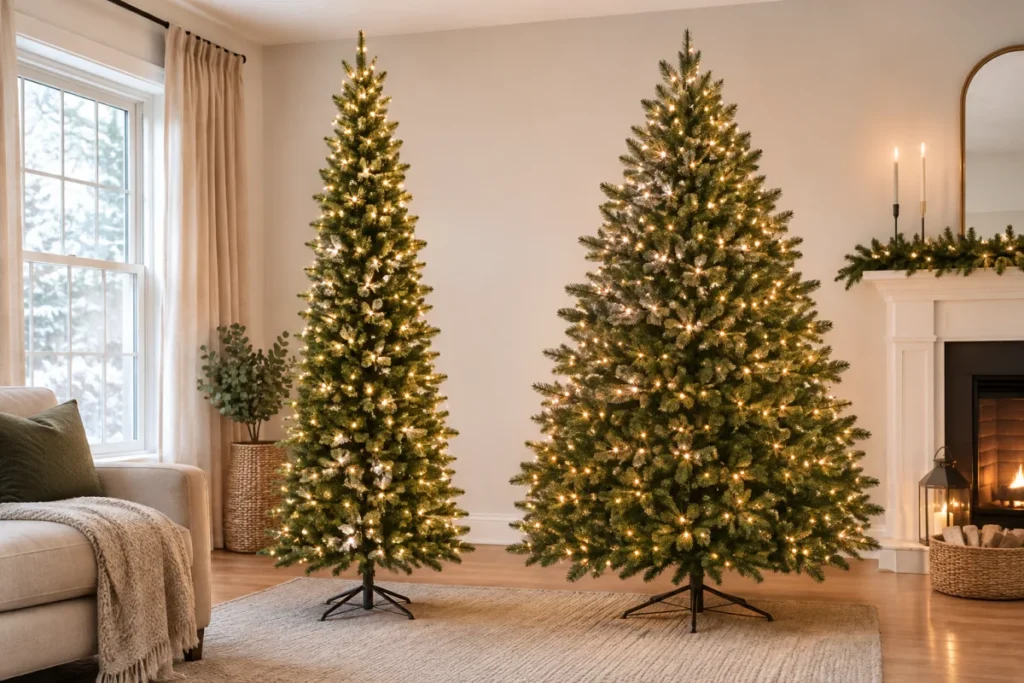
A full 7.5 ft tree has more surface area to light than a narrow tree of the same height. That means two trees can share a height and bulb count but feel completely different once shaped. A pencil or slim tree places lights closer together around a smaller frame, while a wide fir silhouette spreads those bulbs across deeper branches.
If you are shopping for a hallway, apartment corner, or tight living room layout, a slim option such as the Balsam Hill Silverado Slim 7 ft LED Clear Lights is the kind of profile where the shape itself affects how dense the lighting appears. The same logic works in reverse for a broad family-room tree: a mid-range bulb count may look softer once the branches are fully opened.
Branch material matters too. PE tips are molded for a more realistic needle shape, while PVC tips are often used to create fullness at a lower cost. Neither material automatically tells you whether the lighting will look good, but fuller outer branches can catch and partly block the glow. If you are comparing realism and fullness alongside lighting, the PE vs PVC pre-lit tree guide is a useful next read.
Step 3: Compare mini LEDs and micro LEDs carefully
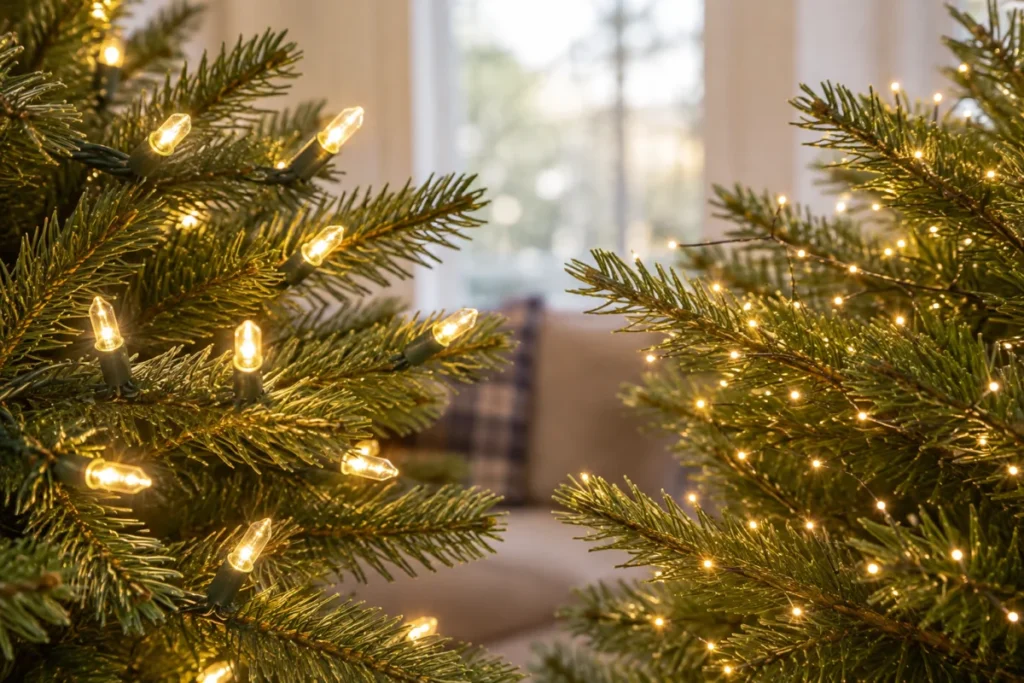
Mini LEDs are the familiar small bulbs found on many pre-lit artificial trees. Micro LEDs are smaller, so manufacturers may use a much higher count to create a fine, sparkling effect. A 1,500-light micro LED tree is not automatically brighter than a 1,000-light mini LED tree; the bulbs are doing a different visual job.
For mini LEDs, the height benchmark above is a helpful starting point. For micro LEDs, look beyond the raw count. Check product photos in both daylight and evening-style settings when available, and pay attention to whether the lights are concentrated near the branch tips or woven deeper into the tree. Tip lighting can look crisp and decorative; deeper placement can make the whole tree glow from within.
Step 4: Decide what kind of holiday mood you want
The right count also depends on the room. A tree beside a fireplace or soft lamp may not need as many bulbs to feel magical. A tree in a bright open-plan room, a vaulted entry, or a space with lots of daylight often benefits from a higher count because the glow has more visual competition.
Use these styling targets as a practical filter:
- Cozy and traditional: choose the lower or middle part of the balanced range, especially with warm white lights and classic ornaments.
- Polished and full: aim for the middle to upper balanced range, particularly on a 7.5 ft or 9 ft tree.
- Bright and celebratory: look above the balanced range, especially if the tree is the room’s main evening light source.
- Minimal and modern: a lower count can work beautifully on sparse or alpine-style trees, where visible space between branches is part of the design.
- Family-colorful: multicolor or dual-color lights often feel lively even before ornaments, so the bulb count does not need to do all the work.
Step 5: Factor in ornaments, ribbon, and flocking
Decorating style changes how much light you actually see. Large ornaments, wide ribbon, garlands, and dense picks can cover bulbs, especially on branch tips. If you love a heavily dressed tree, choose the upper half of the balanced range or higher. If your style is airy glass ornaments and a few keepsake pieces, a middle-range count usually gives the lights room to sparkle.
For a 7.5 ft tree, lighting and ornament density should be planned together. A tree with 700 to 1,000 built-in lights can feel nicely balanced with a moderate ornament plan, while a brighter tree can support more layers without going visually flat. For the decorating side of that decision, see how many ornaments to buy for a 7.5-foot pre-lit tree.
Common light-count mistakes
- Judging by height only: width and branch depth change how far the lights have to spread.
- Assuming more is always better: very bright trees can overpower delicate ornaments or small rooms.
- Ignoring bulb type: micro LED counts and mini LED counts should not be treated as equal.
- Forgetting the finish: flocked trees can soften and diffuse light, which may call for a higher count if you want strong sparkle.
- Skipping the setup reality: a high light count is lovely, but the tree still needs to be fluffed carefully so branches do not hide the bulbs.
Key questions answered
Is 700 lights enough for a 7.5 ft Christmas tree?
Yes, 700 lights can be enough for a 7.5 ft tree if the shape is slim to medium and the decorating style is not overly dense. For a fuller or heavily decorated 7.5 ft tree, 900 to 1,000 lights will usually look more balanced.
Is 1,000 lights too many for a 7.5 ft tree?
Not usually. On a 7.5 ft tree, 1,000 standard mini LEDs sits at the bright end of a balanced range. It is a strong choice for a full tree, a darker corner, or a room where the tree is meant to be the main festive glow.
How many lights should a 6.5 ft pre-lit tree have?
For a 6.5 ft tree with standard mini LEDs, 500 to 800 lights is a practical balanced range. Choose closer to 500 for a softer look, and closer to 800 or above for a brighter, more decorated effect.
What to remember
Choose the light count the way you choose ornaments: by scale, mood, and how the whole tree will live in the room. For standard mini LEDs, 75 to 125 lights per foot is the most useful starting point. Go lower for a gentle glow, higher for drama, and always adjust for width, branch fullness, flocking, and the amount of decorating you plan to add.
If you are stuck between two similar trees, picture the tree at the time you will enjoy it most. Evening movie nights, Christmas morning photos, and holiday parties all reward a slightly different glow. A softer light count can feel beautiful and calm in a snug den, while the brighter option often makes more sense in a tall foyer, sunny living room, or space where the tree needs to hold its own from across the room.
Also remember that pre-lit trees are harder to “turn down” visually than they are to brighten. You can add a few extra strands deep inside a tree that feels too dim, but you cannot easily remove built-in brightness. If you love delicate glass ornaments, metallic ribbon, or a pared-back designer look, leave enough breathing room for those details to shine instead of choosing the highest count by default.
Once the tree is assembled, fluff before judging the lights. Properly opened branches spread the bulbs more evenly and can make a moderate light count look much richer.